Why Do Trees Shed Tears?
“Dad, why is that tree crying?” I remember this line from when we were walking near Hraniční Pond, not far from Kytlice, and I was taking pictures of resin dripping from a mighty spruce. When I looked around, I saw that many spruces were shedding tears.
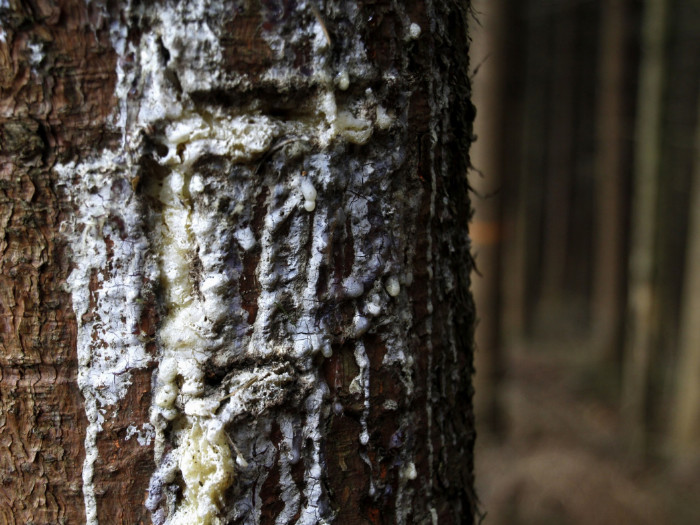
It looked just like a bunch of friends who had been chopping onions together a moment ago. Gallons of white resin were flowing from their trunks, and it seemed as if they were crying. Unfortunately, those trees no longer stand there today. The bark beetle destroyed them, and they got chopped down.
When resin, or sap, oozes from the cracks and hollows in a tree's bark, it’s a sign that the tree has been injured or attacked. Nowadays, it’s especially noticeable in forests where beetle-infested trees are being chopped down, and the trees are quite "scraped up" by the logging. In a healthy forest, however, branches occasionally fall on their own or a dry branch from a neighboring tree gets blown off in the wind. Such a branch can easily leave a large gash in the bark of a neighboring tree. A tree can’t dodge a falling branch like a human can. Droplets of resin immediately start to form in the open wound, as the tree tries to seal the wound to prevent infection. The resin channels within the tree, which transport the resin, go into overdrive, quickly sending liters of sap to the injured spot. The tree is repairing itself, trying to heal. Nature is powerful.
But sometimes the injury is so severe that the tree can’t fix it on its own. The wounded spot begins to dry out, or fungal spores, bacteria, or parasites can enter the open wound within minutes. The parasite begins to grow, spreading like mold, and the tree slowly suffers and dies. It can take decades for a weakened tree to succumb. However, sometimes the tree manages to close the wound and suffocate the parasite inside.
It’s Like Scraping Your Knee
Exactly. When a little boy scrapes his knee during his adventures, tiny droplets of white fluid—tissue fluid—along with some blood, immediately appear. The skin begins to repair itself, and the body defends against possible infection. Quickly, so no virus notices, fast, fast. And when a scab finally forms over the wound, it’s a victory.
Trees do the same. They try to quickly form a resinous scab on their bark to prevent infection, fungus, or parasitic insects from entering.
Can Trees Defend Themselves? Maybe From Bark Beetles?
The whole debate about the omnipresent bark beetle is complicated, and I don’t have enough knowledge to evaluate it properly. I can only share my experiences and maybe speculate a little. The bark beetle has always been present in our forests. It looked for weaker trees. And when it found them, it made its home. A healthy tree, however, is prepared for such an intruder. It knows how to allocate its resources for the year, growing a little, feeding its leaves, nourishing its helpful fungi, and setting aside some to defend itself. When the insect burrows beneath the bark and starts to tunnel, the tree immediately fights back. It takes a deep breath, rustles, and sends its antibiotics to the spot where the insect is piercing. The tree releases its sap and resin to seal the insect’s path, suffocating it. It creates a healing scab where the resin is, and when the tree needs to expel a lot of resin, it flows in rivers of sticky sap down the trunk. It looks as if the tree is crying.
In one of my favorite books, The Secret Life of Trees by Peter Wohlleben, in the chapter "The Sick Tree," Peter mentions that trees have brutal antibiotics at their disposal, called phytoncides:
“In 1956, Leningrad biologist Boris Tokin observed the following phenomenon: When a drop of water containing protozoa is mixed with a tiny amount of crushed spruce or pine needles, the creatures die in an instant.”
That’s why the forest smells so nice. The trees, releasing their phytoncide disinfectant, effectively make the forest sterile.
Why Is the Bark Beetle Winning?
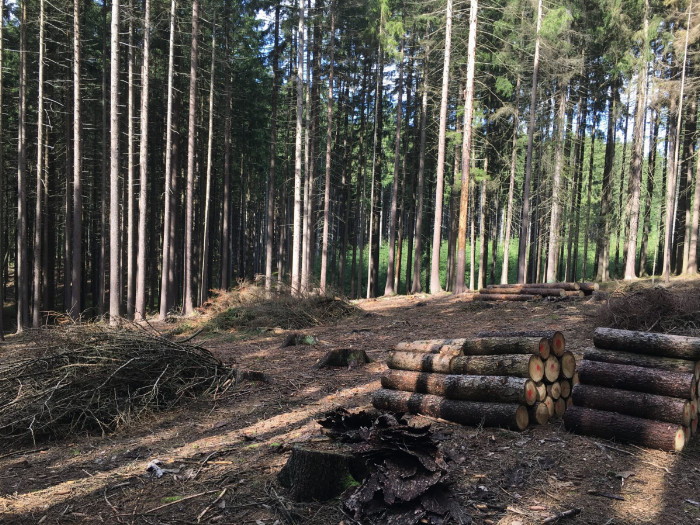
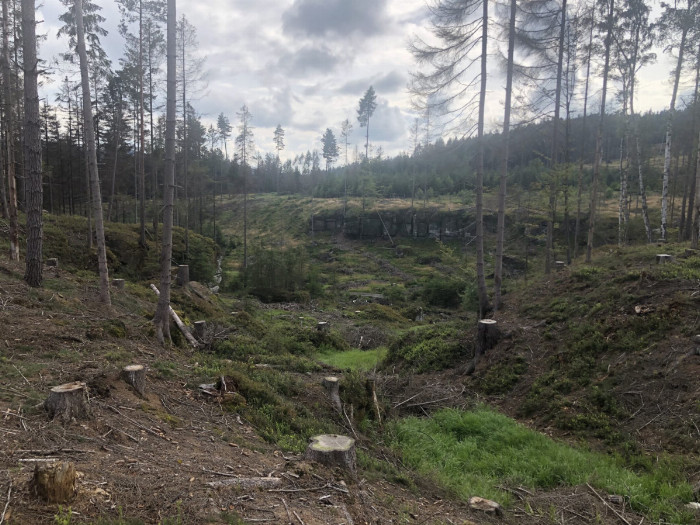
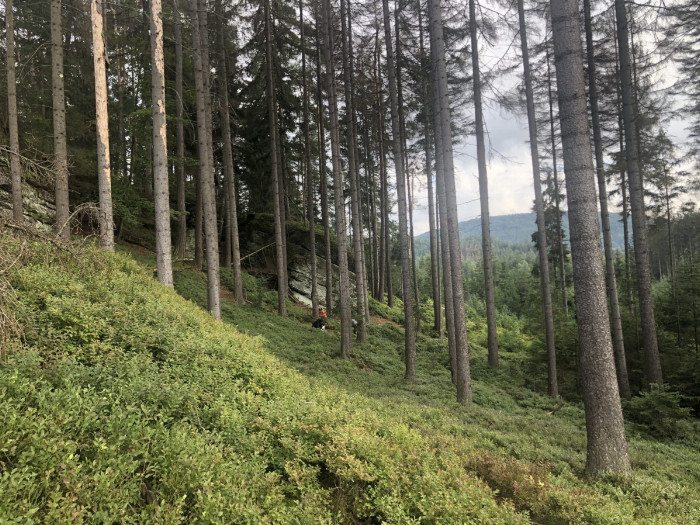
The bark beetle outbreak has ravaged the whole of the Czech Republic in recent years. My favorite spots, where once healthy forests grew, are now just clear-cut patches. Huge piles of cut trees lie along the roads. The once planted spruce plantations are now barren, harvested by the foresters. It’s sad. The places I knew from camp in the Lužické Mountains are now barren. The once warm forest in the Valley of Winding Waters near the country’s border is no more. The forest where we played night games at Slunečná Paseka near Pelhřimov is gone.
Every time I think back to a quiet warm night at Slunečná Paseka, when we played a night game, with kids searching for new territory quietly under the forest lights, I remember sitting in a position deep in the woods, illuminated only by two chemical lights. Otherwise, it was pure darkness. A magical night, with silence. I sat under a mighty spruce, feeling the magic of the forest. I heard the sound of pine needles falling. The whole forest was dying. I sat there alone, waiting for the first kids to find this place, as pine needles fell on my head, and the forest mourned. That tree isn’t there anymore. Just a big stump. This year, I went back to the camp to visit that spot and reminisce, but it was a sad memory.
Why Is the Bark Beetle Winning, When Every Tree Can Defend Itself and Kill the Insect Instantly?
Because the trees no longer have the strength. In recent years, there’s been so much drought that the spruces didn’t have enough moisture. And when a tree doesn’t have water, it starts to dry out. Without water, it can’t produce enough resin to fight off all its natural enemies. And that’s when the bark beetle strikes. Once it realized the trees couldn’t defend themselves, it attacked.
And since the bark beetle mainly targets conifers, its attack and devastation were quick. The original mixed forests that used to be common here are now in the minority. The beetle can travel up to 300 meters, tree to tree, and it swept across the Czech landscape like a knife through a birthday cake. Nothing stood in its way. And when the much-needed rainy season finally arrived, it was already too late.
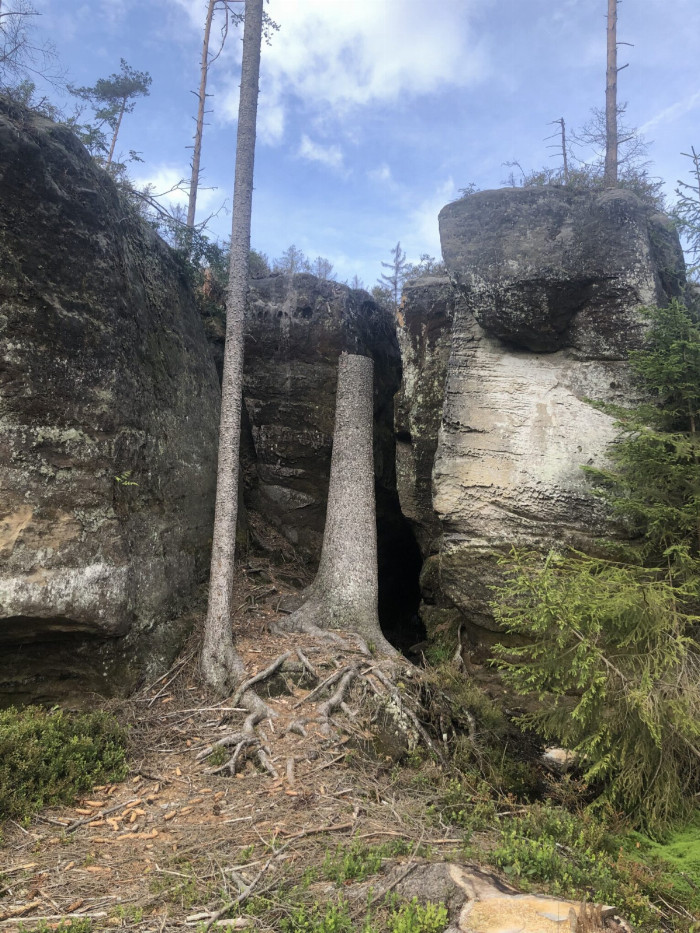
So Now I Visit the Clearings with Newly Planted Saplings. I go to look at the clearings with newly planted saplings. They grow fast because they aren’t shaded by any large relatives. They race toward the sun, headlong, crowns or no crowns. And it’s good that, for the most part, they’re planted as mixed forests, with both deciduous and coniferous trees. I’m rooting for them, hoping they have plenty of strength. And water.
And Why Do We Say "You Have Bad Luck"?
That’s something I’d like to know too. Perhaps today, that saying has a different meaning. But I see resin as a wonderful creation by nature, a defense mechanism for all trees. It’s always been used by people to make torches, lighting the way through history. It’s used in cosmetics and jewelry. You’ve probably heard of the mysterious Amber Room? Or rather, the resin room. Violinists use resin to create beautiful melodies on their string instruments. And as we all know, resin sticks and glues almost anything.
So, even though it may look like trees are crying, in reality, these are more like tears of joy.

Ronin born from the beech, simply a Beechboy
I work with youth, organizing outdoor adventure events for families, children’s camps, and travel camps. In my work, I focus mainly on the relationships between fathers and their sons, raising awareness of true masculinity, the upbringing of today’s boys, and awakening their dads. As part of this therapeutic work, I run a non-profit organization with a group of friends called Goodman, with its development program, Goodman Road. I'm a huge lover of nature and a storyteller of forest creatures. My beliefs are: The right man can only be raised by another man. A Good man. And another one: Protect the trees, learn to listen to them, and in doing so, we will save ourselves.
Klid se dá naučit.
Začněte s Calmory ještě dnes.
Dostupné nyní pro iOS a Android

Naskenujte QR
a stáhněte si aplikaci