Your Life Stories Can Also Help Others
Every man, whether young or old, is shaped by his life stories. Whether they are positive or rather painful. It all counts. Our life throws everything into one basket, into a life blender, mixes it all together, and from that mash, it continues to shape our character. And as they say, some stories are priceless. They are not so easily lived through. And that’s why we shouldn’t keep them just for ourselves, and if possible, we should use them to pass on our life experiences to others.
Storytelling in the Circle Around the Fire
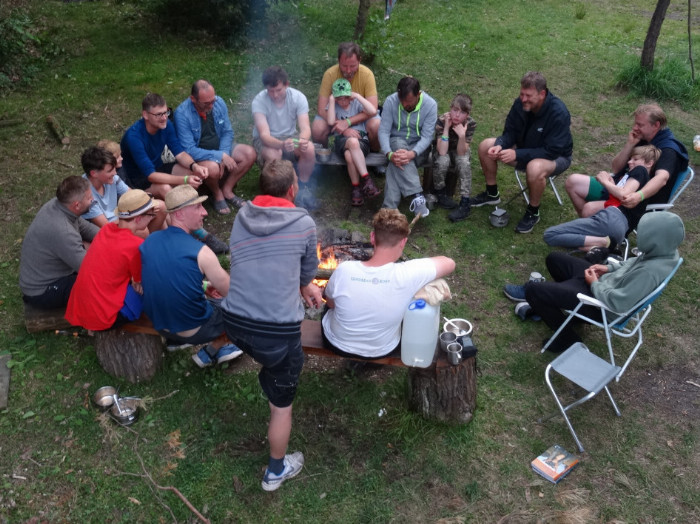
Fire and sitting in a circle around it is the ideal place and time for storytelling. The old Native Americans passed on their experiences in a circle—stories from battles, buffalo hunts, the wisdom of the seasons, and the history of their tribe. The young listened in the second row while the elders told the stories at the front. Whoever had the word spoke. The others listened. Anyone could speak; every word counted.
Later, sitting around the fire moved more into cottages and by the stoves. But the stories continued to be passed on. Writing was not yet widespread, and most men couldn’t read or write. But the stories spoke for themselves, without letters carved into clay tablets or printed on paper. The old men spoke, and the young men listened.
Today, storytelling is rather rare. The digital world tells stories for us—more and more of artificial intelligence. We no longer ask, Grandpa, what was it like during the war? Dad, how did you build our cottage? Why do we have this kind of relationship with our neighbors? Nowadays, it seems the older generation is catching up with the young in mastering modern technology, and the young no longer ask why grandpa spends his time walking and chatting with friends. Why does dad need this and that tool to work with wood when you can just buy a ready-made panel online from a hardware store? The young are ahead; everything moves fast. Stories are not told. They are no longer needed.
“But are they really not needed?”
Good Men Listen to the Stories of Others
With our community of good men and their sons—Goodmen —we spend a lot of time outdoors and on the road throughout the year. Every evening, we try to sit in a circle around the fire and tell various stories from our lives. What it was like when we fathers were small, as young as our sons. What mischief we got up to. What love we experienced, how we started families. How we learned our trades, where we gained our expertise. Some of us are mechanics, some accountants, some businessmen. Some work with their hands, others with their minds. Each of us is an expert in something different.
In the circle, we discuss family relationships, we listen. We don’t criticize, we just tell stories. And the young ones ask. They listen. They see how things work in other families, they sort out their thoughts, and they adjust their often critical opinions. Through storytelling, we fathers give them an enormous gift—one that money can never replace. We give them real stories.
During our events with Goodmen, we follow four basic principles promoted by Arne Rubinstein. Arne is an internationally recognized expert on rites of passage and teenage development. For over 20 years, he has led Rites of Passage programs for teenagers and provides top leadership training in Australia and internationally. I personally met him at a conference (dedicated to masculinity and youth upbringing), and he is a very kind and experienced guy.
The Philosophy and Methodology of Life According to Arne R.:
- Tell your life stories (Tell and inspire with your expertise and wisdom.)
- Build a community and be an example to its members (Bring people back to life through your expertise, hobbies, and lifestyle.)
- Create challenges and let people in the community complete them (Present your life challenges, show others how you overcame them, create new ones, and be an example.)
- Inspire others and help them discover their own talents and set a life vision (at least some part of it).
I think these four points are enough to get an idea. Everyone can probably imagine what they mean.
Find Your Direction Through Storytelling
Around the age of fifty, the so-called midlife crisis comes. The kids slowly “disappear from home,” and it’s common to feel less passion for our current jobs. Around this age, even previously strong relationships often fall apart. This happens because people lose their previous sense of purpose and start searching for a new one. They feel lost, uncertain, and they lash out at those around them.
So, why not take inspiration from the four principles mentioned above in this stage of life? Surely, you are good at something, and you can pass on your expertise and wisdom to others. See it as a personal challenge. It works for us with Goodmen.
What do you think? Will you give it a try?

Ronin born from the beech, simply a Beechboy
I work with youth, organizing outdoor adventure events for families, children’s camps, and travel camps. In my work, I focus mainly on the relationships between fathers and their sons, raising awareness of true masculinity, the upbringing of today’s boys, and awakening their dads. As part of this therapeutic work, I run a non-profit organization with a group of friends called Goodman, with its development program, Goodman Road. I'm a huge lover of nature and a storyteller of forest creatures. My beliefs are: The right man can only be raised by another man. A Good man. And another one: Protect the trees, learn to listen to them, and in doing so, we will save ourselves.
Klid se dá naučit.
Začněte s Calmory ještě dnes.
Dostupné nyní pro iOS a Android

Naskenujte QR
a stáhněte si aplikaci